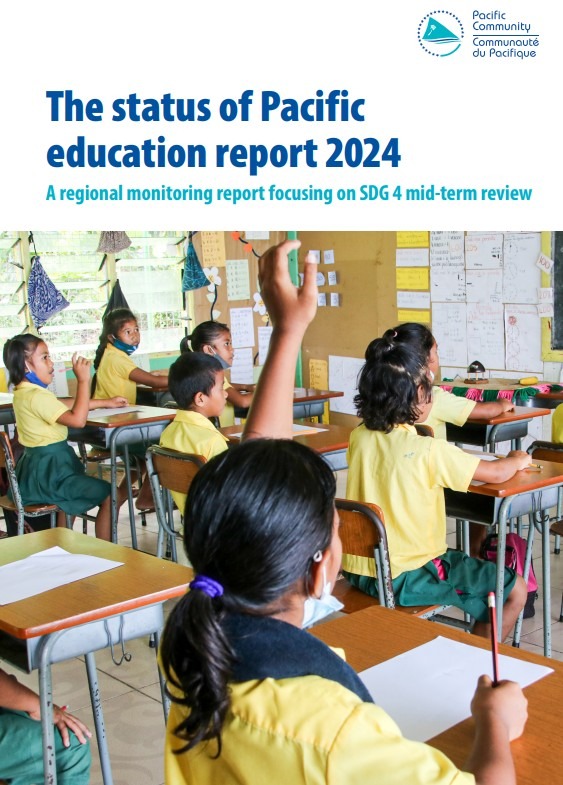
The Status of Pacific Education Report 2024 (SOPER24), released by the Pacific Community (SPC) in March 2025, serves as a mid-term review of SDG 4 and highlights progress in Pacific Island countries since 2016. It provides key data on education quality and resilience, helping policymakers navigate education challenges.
The report serves as a regional monitoring tool for the mid-term review of the Social Development Goal (SDG) 4, tracking progress toward quality education. Produced by SPC’s Educational Quality and Assessment Programme (EQAP) in collaboration with the UNESCO Institute for Statistics (UIS). It covers 80 pages of in-depth analysis on the educational landscape, including access, quality, and outcomes. It is the third edition of the biennial series and was launched at the Conference of Pacific Education Ministers (CPEM) in Port Moresby, Papua New Guinea, to inform regional education ministers, senior executives, and partners about key trends, successes, and emerging challenges in education across the Pacific.
At the midpoint of the Education 2030 agenda, the Status of Pacific Education Report 2024 (SOPER 2024) arrives as both a progress report and a provocation.
Launched in 2025 as the Pacific region’s flagship SDG4 monitoring report, SOPER 2024 offers an important overview of where education systems across Oceania stand today, and, perhaps more importantly, where deeper challenges remain.
In many ways, the report tells two stories at once.
The first is a story of progress.
Across Pacific Island countries, educational access has expanded over recent decades. Participation in early childhood education has improved, regional collaboration has strengthened, and education systems across the Pacific have increasingly shifted their focus beyond access alone toward broader questions of quality, inclusion, and resilience.
The second story, however, is more sobering.
Progress remains uneven, and increasingly fragile.
In several contexts, primary out-of-school rates are beginning to rise again. Secondary completion rates remain persistently low across many Pacific education systems, while inequalities linked to wealth, geography, gender, and access to resources continue to shape who succeeds within education and who remains excluded from it.
Perhaps most concerning are the silences within the data itself.
SOPER 2024 highlights significant gaps in regional education data, particularly around disability, teacher quality, workforce development, and secondary education outcomes. These gaps matter because what remains invisible within education systems often also remains under-prioritised in policy responses and resource allocation.
As the report makes clear, measurement alone is not enough.
For comparative and international education scholars across Oceania, SOPER 2024 raises deeper questions about what counts as educational progress, and whose knowledge systems shape how progress is defined in the first place.
What does “quality education” actually mean within Pacific contexts?
Whose values, aspirations, and realities are reflected in global educational indicators?
And how do education systems respond when internationally standardised measures fail to fully capture local experiences, Indigenous knowledge systems, and culturally grounded understandings of learning and wellbeing?
These are not new questions within Pacific education scholarship. For many years, Pacific researchers, educators, and communities have argued that education systems must be locally grounded, culturally responsive, and regionally led rather than simply measured against externally imposed frameworks.
In this sense, SOPER 2024 reinforces a long-standing Pacific insight: educational transformation cannot be separated from questions of culture, context, language, identity, and relationality.
At the same time, the report positions inequality as one of the defining educational challenges facing the region.
While educational participation has expanded overall, access to meaningful and successful educational experiences remains deeply uneven. Wealth continues to shape educational opportunity, while geographic disparities between urban and rural communities remain significant across many Pacific contexts. Gendered patterns of participation and achievement also continue to vary across the region in complex ways.
Importantly, the report also highlights the growing need to move beyond narrow understandings of access toward broader conversations about participation, belonging, retention, completion, and educational success.
This shift feels especially significant as the Oceania Comparative and International Education Society (OCIES) prepares for its 54th Annual Conference at Solomon Islands National University in November 2026.
The conference theme — “Reimagining Education in Oceania: Indigenous Knowledge, Equity, and Sustainable Futures” — speaks directly to many of the tensions and possibilities raised within SOPER 2024.
Together, they remind us that the work of comparative and international education in Oceania cannot stop at monitoring educational systems. It must also ask how those systems might be transformed.
This includes:
- centring Indigenous and Pacific knowledge systems within educational thinking and policy
- strengthening Pacific-led research and regional data capacity
- moving beyond access toward meaningful participation and educational success
- building stronger relationships between research, policy, and practice across the region
In many ways, SOPER 2024 is more than a monitoring report.
It is an invitation.
An invitation to rethink how educational progress is measured, understood, and pursued across Oceania.
An invitation to move beyond documenting inequality toward actively challenging it.
And perhaps most importantly, an invitation to imagine educational futures that are not only globally connected, but deeply grounded in the knowledge systems, aspirations, and lived realities of Pacific communities themselves.
You can access a full copy of the report here.