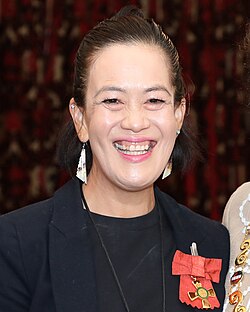
When people speak about Associate Professor Cherie Chu-Fuluifaga, they often speak first about relationships.
Former students speak about mentorship, encouragement, and being seen. Colleagues speak about generosity, leadership, and a deep commitment to creating pathways for others. Across Aotearoa New Zealand and the wider Pacific region, Cherie is widely recognised not only for her scholarship, but for the communities she has helped build.
It is fitting, then, that her appointment as Co-President of the Oceania Comparative and International Education Society (OCIES) feels less like a routine leadership transition and more like a continuation of a long-standing commitment to nurturing scholarly communities across Oceania.
For Cherie, education has always been about people.
In her candidate statement, she described OCIES as more than an academic society, calling it “a community” grounded in curiosity, courage, and collaboration. Those ideas have shaped much of her work across Pacific education, mentoring, leadership development, and Indigenous scholarship over more than two decades.
As an Associate Professor at Victoria University of Wellington, Cherie’s scholarship sits at the intersection of comparative and international education, Indigenous education, Pacific studies, mentoring, and leadership. Her work is deeply informed by her Chinese Tahitian heritage and shaped by years of engagement with Pacific communities, educators, and researchers across the region.
One of the strongest threads running through her career has been mentorship.
In 2000, she established a mentoring programme for Pacific students at Victoria University of Wellington, work that later expanded into a Pacific Education Leadership Cluster supporting postgraduate Pacific scholars and emerging educational leaders. Over the years, many of those students have gone on to leadership roles across education, academia, government, and community sectors throughout Aotearoa and the Pacific.
Underlying this work is a consistent belief that educational success is relational.
Her research has explored mentoring not simply as academic support, but as a transformative process through which Pacific learners can develop confidence, belonging, and leadership within higher education. Her scholarship has also contributed to wider conversations about appreciative pedagogy, culturally sustaining education, and Indigenous knowledge systems.
These commitments resonate strongly with the evolving identity of OCIES itself.
Over the past decade, the Society has increasingly positioned itself as a relational, regionally grounded scholarly community, foregrounding Pacific and Indigenous knowledges within Comparative and International Education. Cherie’s appointment reflects and strengthens this direction.
In her candidate statement, she writes that education systems thrive when they “honour cultural knowledge” and listen to the voices of communities. She also speaks about nurturing spaces where emerging scholars — particularly Indigenous, Pacific, and historically marginalised voices — can develop “confidence, rigor, and purpose.”
This commitment to supporting the next generation feels especially significant within OCIES, particularly through initiatives such as the New and Emerging Researchers of OCIES (NERO), which continues to create supportive spaces for postgraduate students and early career researchers across the region.
In 2024, Cherie was appointed an Officer of the New Zealand Order of Merit (ONZM) for services to education — recognition of decades of contribution to Pacific education and leadership development. Yet even alongside these achievements, many reflections on her work return to the same theme: the ability to create spaces where others can flourish.
As OCIES looks toward its future, Cherie Chu-Fuluifaga’s appointment reflects a vision of Comparative and International Education in Oceania that is relational, community-grounded, and attentive to the diverse knowledge traditions carried across our region.
In her own words, comparative education reminds us that “our differences are not obstacles” but “sources of insight, of strength, of growth.”